
English


Views: 0 Author: Site Editor Publish Time: 2026-10-08 Origin: Site


Picture a bustling Saturday afternoon at the local park. Children laugh, swing, and race up climbing frames. Parents usually focus on the towering structures. Yet, the unsung hero of this vibrant scene lies right beneath their feet. Falls account for the vast majority of playground injuries. Choosing an inadequate surface jeopardizes child safety. It also translates to exorbitant repair costs down the line.
Whether upgrading an existing recreational space or building a new play area from scratch, this guide covers everything about playground flooring and surfacing. Understanding material nuances and installation methods helps you make a safe, budget-friendly, and long-lasting choice.
Safety First: Proper playground flooring and surfacing is legally and ethically required to meet critical fall height standards and ADA accessibility guidelines.
Material Variety: From poured-in-place rubber to playground rubber floor mats, every material presents distinct specifications, maintenance demands, and price points.
Equipment Synergy: Your surfacing choice must physically align with your play structures to prevent high-wear zones, particularly under slides and swings.
Long-Term ROI: Upfront installation costs should always be weighed against long-term maintenance, top-off requirements, and durability to determine the true lifecycle cost.
In facility management, the foundation beneath the equipment is just as critical as the structures themselves. Selecting the appropriate playground flooring and surfacing is a non-negotiable aspect of park design. Safety regulations, accessibility laws, and long-term durability drive this necessity.
The Role of Shock Absorption
A surface must absorb the kinetic energy of a falling child. This drastically reduces the risk of severe head injuries. Engineers measure this using Critical Fall Height, or CFH. The CFH rating must meet or exceed the highest designated play surface. For instance, if you install a multi-level structure with a deck height of 1.5 meters, the surfacing beneath must be scientifically certified to absorb impacts from that specific elevation. Materials undergo rigorous ASTM F1292 testing to ensure adequate shock absorption across fluctuating weather conditions.
ADA Compliance and Accessibility
Modern recreational spaces must champion inclusivity. The Americans with Disabilities Act mandates that public play areas be accessible to wheelchairs and walkers. This requires a firm, stable, and slip-resistant surface year-round. Loose-fill materials like uncompacted sand inherently fail this requirement. Unitary surfaces provide the necessary stability. Compliance is typically verified through ASTM F1951 testing, which measures the mechanical work required to propel a wheelchair across the terrain.
Aesthetics and Play Value
Beyond strict safety and compliance, the visual integration of the surface with the equipment amplifies the overall environment. Thoughtfully designed surfacing incorporates vibrant patterns or directional cues. These instinctively guide children through different play zones. Matching the surface design with premium outdoor playground systems helps facility managers cultivate a cohesive and highly functional space.
Looking at current industry trends, there is a massive shift toward climate-resilient and sustainable playground surfaces. Urban temperatures are rising due to the heat island effect. Consequently, facility managers are moving away from traditional dark rubber that absorbs heat. There is a surging demand for lighter-colored aliphatic poured-in-place systems and organic engineered wood fibers that naturally stay cooler. Sensory-inclusive designs are also becoming an industry standard. This pushes the need for seamless unitary surfaces that effortlessly accommodate mobility aids and eliminate tripping hazards for children with dyspraxia or visual impairments.
Understanding technical distinctions between materials is essential for an informed purchase. Surfaces generally fall into two main categories: unitary and loose-fill. Let us break down the engineering specs.
Material Type | Upfront Cost | Maintenance Level | ADA Accessibility | Lifespan |
|---|---|---|---|---|
Poured-in-Place Rubber | High | Very Low | Excellent | 10 to 15 Years |
Rubber Floor Mats | Medium to High | Low | Great | 8 to 12 Years |
Engineered Wood Fiber | Low | High | Moderate | Requires Annual Top-offs |
Rubber Mulch | Medium | Moderate | Poor | 10+ Years |
Unitary surfaces consist of materials bound together to form a continuous layer. They dominate commercial settings due to minimal maintenance and superior accessibility.
Poured-in-Place Rubber: Engineered for durability, this two-layer system is mixed and troweled on-site. The cushion layer utilizes recycled styrene butadiene rubber to attenuate impact. Above this, a vibrant wear layer of ethylene propylene diene monomer granules delivers UV resistance. It offers flawless ADA accessibility and an impressive lifespan. However, it carries a steep initial cost and demands specialized professional installers.
Playground rubber floor mats: These pre-manufactured, interlocking squares are crafted from high-density rubber. Fabricated in a controlled environment, their density and CFH ratings remain exceptionally consistent. They are outstanding for targeted high-impact zones. If a single tile suffers damage, maintenance crews can swap it out individually. Over the years, seams may separate if the sub-base shifts.
Artificial Turf: Modern turf systems marry the natural look of grass with commercial-grade resilience. The turf blades do not offer fall protection. Instead, they rely on a specialized foam shock pad meticulously installed beneath. This stays significantly cooler than solid black rubber. It does require ongoing infill maintenance to keep the blades standing upright.
Loose-fill materials consist of individual particulates that displace upon impact. They present a more budget-friendly upfront price but demand strict ongoing maintenance.
Engineered Wood Fiber: Unlike standard landscaping wood chips, EWF is mechanically shredded wood designed to knit together. It forms a firm, springy surface. It blends beautifully into natural park settings and offers robust fall protection when maintained at the correct depth. Maintenance teams must perform strenuous weekly raking and annual top-offs to replenish decayed material.
Rubber Mulch: Manufactured from shredded recycled tires, rubber mulch delivers exceptional shock absorption. It entirely bypasses the decomposition issues associated with wood fiber. It never rots and achieves superior impact attenuation at shallower depths. Active children often kick it outside the play border, requiring frequent sweeping.
Selecting the optimal surface requires a delicate balance between upfront capital, maintenance capabilities, and localized environmental factors. Follow these actionable engineering guidelines.
Municipal parks endure hundreds of enthusiastic users daily. They require heavy-duty, commercial-grade unitary surfaces or meticulously maintained EWF to strictly adhere to safety standards. A backyard oasis experiences minimal foot traffic. Residential buyers can safely utilize high-quality rubber mulch or thinner rubber tiles. Just ensure the surface depth accurately matches the fall height of the home play structure.
A frequent purchasing blunder is fixating solely on the initial invoice. Loose-fill materials appear incredibly cost-effective on day one. Factor in the labor costs for weekly leveling and material expenses for annual top-offs. The ten-year lifecycle cost of EWF often eclipses unitary surfaces. Poured-in-place rubber demands a larger upfront capital expenditure but delivers a phenomenal return on investment through drastically reduced maintenance labor.
Local climate heavily dictates material performance. In regions battered by intense sun, UV rays break down standard polyurethane binders. Upgrading to a premium aliphatic binder is a necessary protective expense. In areas prone to torrential rain, drainage becomes the primary concern. EWF can quickly become waterlogged and rot if the sub-base lacks proper grading.
Selecting a high-quality material is only one piece of the safety puzzle. The physical layout of the play area dictates overall compliance. Facility managers must carefully calculate safety perimeters and anticipate patterns of heavy physical wear.
A Use Zone is the designated surface area beneath and immediately adjacent to play equipment. This specific area must be blanketed with impact-absorbing material. For stationary equipment like freestanding play panels, the use zone typically extends a minimum of six feet from the perimeter. Moving equipment requires far more extensive spatial calculations. The use zone for a standard swing set must extend to the front and rear a distance equal to twice the height of the suspending pivots. Underestimating required square footage routinely leads to severe safety violations.
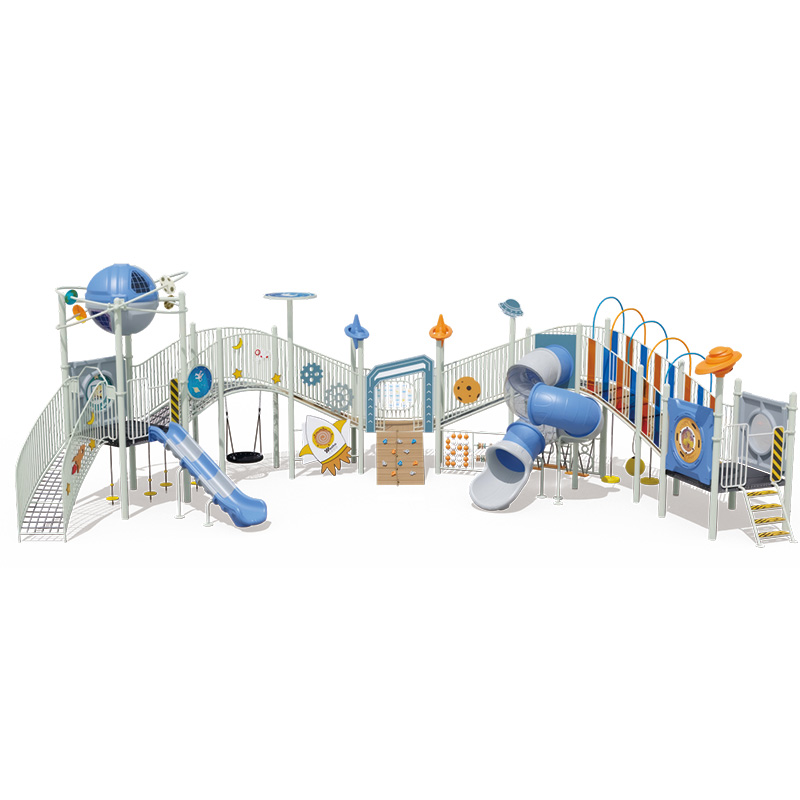
Not all areas of a playground experience the same level of friction. The exit points of combination slide equipment, the ground directly beneath swing seats, and landing zones endure continuous mechanical stress. For instance, a space-themed combination slide featuring LLDPE plastic tubes and galvanized steel posts will concentrate foot traffic heavily at its exit chute.
In loose-fill environments, this repetitive scuffing causes trenching. This hazardous phenomenon exposes the hard sub-base beneath and entirely neutralizes shock absorption. Even resilient unitary surfaces eventually thin out in these specific high-stress bottlenecks.
Industry experts strongly recommend integrating heavy-duty wear mats directly into these landing zones. These high-density mats act as a sacrificial protective shield. They evenly distribute mechanical stress and preserve the surrounding primary surfacing.
Flawless installation is the bedrock of surfacing longevity. Even premium materials will fail prematurely if the sub-base is improperly prepared. Understanding the standard operating procedure ensures your project oversight remains quality-controlled.
Step 1: Site Preparation and Excavation
The installation process initiates with clearing the designated use zone of all organic matter. The site is then excavated to a specific depth. This is determined by the required thickness of the surfacing and the depth of the necessary drainage base. Establishing a perfectly level, mechanically compacted sub-grade is essential to prevent future settling.
Step 2: Drainage and Base Layer Installation
Playground surfaces are intentionally designed to be porous. If water cannot efficiently drain away from the sub-base, it will pool. A standard commercial base layer typically consists of three to four inches of compacted, crushed aggregate stone. High-end poured-in-place rubber often utilizes a cured concrete or asphalt pad to provide absolute stability. A geotextile fabric is laid between the soil sub-grade and the crushed stone to prevent aggressive weeds from growing upward.
Step 3: Edge Restraints
Edge restraints contain loose-fill materials to maintain required depth. They also fiercely protect the fragile outer edges of unitary surfaces from chipping. Common edge restraints include heavy-duty rubber curbs or poured concrete borders. The edging must be securely anchored into the sub-grade and feature a beveled design to ensure seamless wheelchair access.
Step 4: Laying the Surface
Execution varies drastically depending on your chosen material. For loose-fill options, the material is blown or dumped into the contained area and raked. It naturally compacts by roughly twenty percent after a few weeks of active use. For poured-in-place installations, technicians mix rubber granules with a polyurethane binder on-site. The shock-absorbing base layer is poured and troweled flat, followed by a thinner colored wear layer.
A proactive maintenance schedule is the most effective strategy to lower the total cost of ownership. Neglecting routine care exposes children to unacceptable impact risks.
Routine Inspections
Facility managers should execute documented visual inspections on a weekly basis. Key indicators include the removal of foreign debris like broken glass and sharp branches. Staff must use a marked probe to ensure loose-fill materials have not been displaced below the minimum required depth. For poured rubber, inspections focus on identifying separated seams or curling edges.
Cleaning Protocols
Different materials require distinct cleaning methodologies. Loose-fill materials must be regularly raked to level out displaced trenches. For rubberized surfaces, routine sweeping eliminates abrasive dirt that acts like sandpaper on the top layer. Periodic washing with a mild detergent and a low-pressure power washer lifts organic stains. Harsh chemicals or petroleum-based solvents must be strictly avoided as they chemically melt rubber compounds.
When to Replace vs. Repair
Understanding the lifecycle of your flooring prevents minor issues from snowballing into total system failures. Localized trenching or a single gouged rubber tile can be swiftly addressed with patch kits. A surface reaches the end of its functional lifespan when poured rubber exhibits widespread granulation. At this advanced stage, patching is no longer a viable remedy. A full replacement is practically mandated to meet safety standards.
Choosing the right playground flooring and surfacing is a delicate balancing act between your available budget, maintenance capacity, and the ultimate safety of the children. Proper materials act as an invisible shield. They protect users from serious fall injuries while ensuring your facility remains compliant with strict accessibility laws.
By pairing high-quality, impact-absorbing surfaces with premium outdoor structures, you guarantee an engaging environment that withstands the test of time. Take the next step in building a secure, vibrant recreational space. Explore the robust, safety-certified equipment at Cheers Playground today. Ensure your entire project from the towering slides to the protective ground beneath delivers unmatched durability and joy for decades to come.
From an objective safety and accessibility standpoint, poured-in-place rubber and high-density rubber mats are widely considered the safest options. These unitary surfaces provide consistent shock absorption that does not displace under heavy foot traffic. They offer a smooth transition that fully complies with ADA accessibility guidelines.
Costs fluctuate significantly based on material quality, site preparation, and geographic location. Engineered Wood Fiber is generally the most cost-effective upfront option, ranging from three to five dollars per square foot. Rubber mulch typically falls between six and ten dollars. Unitary options require a higher initial investment. High-quality rubber tiles range from eight to fifteen dollars per square foot. Poured-in-place rubber can cost between ten and twenty dollars.
Laying rubber mats directly over grass might seem feasible for a temporary residential setup. It is strictly advised against for commercial or permanent installations. Grass and topsoil are inherently unstable and retain significant moisture. Over time, the soil settles unevenly. This causes mats to separate, curl, and create severe tripping hazards. Rubber mats must always be installed over a properly excavated and compacted sub-base.
The required depth is directly dictated by the Critical Fall Height of the specific equipment. This is the maximum height from which a child could theoretically fall. A slide featuring a 1.8-meter platform requires a significantly thicker shock-absorbing layer than a toddler slide. If utilizing Engineered Wood Fiber, a 1.8-meter fall height typically requires a compacted depth of nine inches. For poured rubber, the manufacturer will specify the exact thickness engineered to safely absorb that specific impact.
The safety of recycled rubber mulch has been extensively scrutinized by various environmental and health organizations. High-quality, certified playground rubber mulch is rigorously processed to extract wire remnants and heavy metals. Current scientific consensus indicates that certified playground rubber surfacing does not pose a significant health risk to children. Buyers must remain vigilant to ensure they purchase materials explicitly manufactured and certified for playground use.
The thickness of poured-in-place rubber is entirely dependent on the maximum fall height of your play structures. Typically, the base cushion layer ranges from one to five inches thick. A structure with a four-foot fall height might only need a 1.5-inch base. A towering structure with an eight-foot fall height will require a much thicker cushion layer, often exceeding three inches. The top color wear layer remains a standard half-inch across all installations.
Poured-in-place rubber is universally recognized as the best playground surface for wheelchair accessibility. Its seamless, unitary design provides a firm and stable path of travel that never shifts or creates ruts. This eliminates the intense physical exertion required to push a wheelchair through loose-fill materials like wood chips or sand. It easily exceeds all ADA compliance testing standards for wheelchair propulsion.


