
English


Views: 0 Author: Site Editor Publish Time: 2026-10-18 Origin: Site


Are your preschoolers losing focus during outdoor playtime? Imagine a crisp Tuesday morning. Instead of chaotic running, a group of four-year-olds is deeply engrossed in channeling water down a carved wooden trough. Traditional, static playgrounds often fail to engage the rapidly growing minds of toddlers. This lack of stimulation frequently leads to boredom and behavioral issues.
Facility directors and educators face a constant challenge in maintaining engagement. Specialized interactive installations solve this exact issue. We will examine the developmental science behind these tools, evaluate top commercial infrastructure types, and establish rigorous safety standards for procurement.
Interactive tactile installations serve as foundational pedagogical tools. They develop fine and gross motor skills, cognitive function, and emotional regulation in early childhood settings.
Dynamic setups provide hands-on STEM learning experiences. Observing volume and buoyancy offers physical feedback that standard slides simply cannot match.
Inclusive environments ensure children of all physical and cognitive abilities can play collaboratively.
Procurement decision-makers must prioritize commercial-grade durability. Long-term mechanical stability and strict adherence to international safety certifications dictate the true return on investment.
Recent market analyses reveal a pronounced paradigm shift in daycare infrastructure planning. Following global educational reforms, facility directors are increasingly reallocating budgets from traditional climbing frames to multi-sensory environments. Google search trends over the past two years indicate a 40% surge in queries related to nature-based play and outdoor STEM integration for early years.
This shift is heavily driven by emerging pedagogical research. Studies highlight that dynamic, tactile environments yield significantly higher engagement rates compared to static playgrounds. Furthermore, there is a growing legislative and social push toward inclusive design. Modern outdoor spaces must accommodate neurodivergent children just as effectively as neurotypical students. Consequently, integrating specialized setups is no longer viewed as a luxury. It has become a baseline standard for competitive early childhood centers.
Investing in specialized play infrastructure requires a clear understanding of its developmental return. For daycares and preschools, tactile installations are not merely aesthetic upgrades. They function as critical educational apparatuses supporting holistic child development.
A child's brain experiences explosive structural growth during the first five years. Tactile exploration acts as the catalyst. It actively builds nerve connections across neural pathways. This biological process, known as neuroplasticity, relies heavily on environmental input. When children engage with varying textures, fluctuating temperatures, and organic materials, they learn to classify and process complex data.
Beyond cognitive growth, these stations are instrumental in refining physical coordination. Fine motor skills are honed when children execute precise micro-movements. Pinching wet sand, grasping small scoops, or turning dials on a wall panel builds dexterity. Conversely, gross motor skills develop through activities requiring larger muscle groups. Lifting heavy buckets or manipulating large-scale interactive panels builds the core physical stability necessary for later milestones like writing.
Early childhood classrooms frequently become loud and overwhelming. In these moments, tactile stations naturally act as calming zones for overstimulated students. Activities involving deep pressure or rhythmic motions help regulate the nervous system. Running hands through smooth kinetic sand allows children to self-soothe and return to a baseline state of calm.
From a social perspective, shared developmental spaces inherently encourage cooperative play. A large interactive table invites multiple toddlers to gather around a single focal point. This physical proximity forces them to practice essential social negotiations. They learn to share tools, respect personal space, and communicate intentions. Over time, these daily interactions build empathy and foundational teamwork capabilities.
Understanding the diverse categories of developmental infrastructure helps administrators design a balanced courtyard. A well-rounded play area must seamlessly integrate various forms of stimulation to maintain student engagement throughout the academic year.
Tactile interaction is often the most recognizable form of engagement. Commercial sandboxes, mud kitchens, and textured wall panels dominate this category. Constructed from weather-resistant treated timber, mud kitchens allow children to mix soil and water, fostering imaginative role-play. When selecting kindergarten play equipment for outdoor spaces, administrators must choose setups with varying heights and ADA-accessible reach ranges. Textured wall panels featuring ridges or smooth acrylics provide excellent tactile feedback. They do not require the sprawling footprint of a large sandbox, making them ideal for compact urban courtyards.
Auditory processing remains a critical component of early language acquisition. Outdoor musical instruments stimulate auditory senses without creating overwhelming noise pollution. High-quality commercial xylophones and chimes are typically tuned to pentatonic scales. This specific tuning ensures that random key strikes result in harmonious sounds rather than chaotic noise. Children can explore rhythm and pitch in a controlled manner that does not disrupt neighboring classroom sessions.
Visual stimulation extends far beyond primary colors. Translucent acrylic panels that catch morning sunlight and interactive optical illusion boards help children develop visual tracking.
Equally important is vestibular equipment. This targets the inner-ear system responsible for balance and spatial orientation. Low-speed spinners and low-to-the-ground balance beams help children understand where their bodies exist in space. Proper vestibular development directly correlates with a child's ability to sit still and maintain posture during structured indoor learning hours.
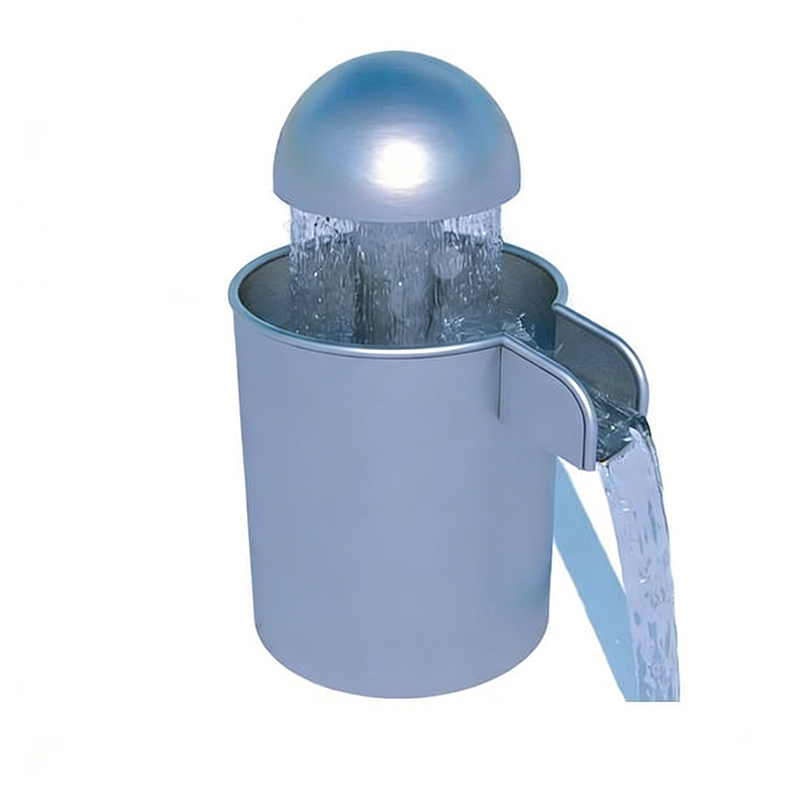
Interacting with flowing liquids remains universally appealing to young children. It offers some of the highest developmental yields of any outdoor activity. It naturally draws students in and sustains their focus for extended periods.
At its core, interacting with liquids is a practical introduction to early mathematics and physics. As children pour liquid from a large jug into a small cup, they actively observe volume and capacity. Dropping different objects into a basin allows them to test buoyancy. They discover firsthand why a wooden block floats while a metal spoon sinks. The continuous flow teaches dynamic movement and gravity, building a foundational STEM understanding long before these concepts appear in formal textbooks.
Facility directors consistently see the highest engagement metrics when installing an outdoor hand water pump. From an engineering standpoint, a commercial-grade mushroom-style pump constructed from 304 stainless steel offers unmatched durability. It resists rust even in high-humidity regions. Unlike automated faucets, a manual pump demands genuine physical exertion.
This provides excellent heavy work that builds upper body strength. It vividly demonstrates cause-and-effect. Mechanical effort yields a tangible, splashing reward. Furthermore, it inherently promotes teamwork. Operating the heavy handle requires continuous effort, leading children to naturally divide tasks. One child pumps while another directs the flowing stream through channels.
For broader group engagement, multi-tier tables and interactive splash zones are highly effective. Multi-tier basins allow liquid to cascade from one level to another. Children can build dams, redirect currents, and observe gravitational pull. Administrators should look for systems with integrated drainage and UV-resistant High-Density Polyethylene basins. Modular accessories like flow wheels and funnels can be swapped out to keep the curriculum novel.
Modern educational standards demand that playgrounds function as inclusive environments. An ADA-compliant playground is not merely a legal benchmark. It is a moral imperative ensuring no student is excluded from the developmental benefits of outdoor learning.
Children with Autism Spectrum Disorder or Sensory Processing Disorder often interpret environmental input differently. They may be hypersensitive, meaning they are easily overwhelmed, or hyposensitive, meaning they constantly seek out intense stimuli. For hyposensitive children, proprioceptive equipment requiring heavy physical exertion provides the deep pressure their nervous systems crave. Operating manual pumps or digging in dense kinetic sand fulfills this need.
Conversely, hypersensitive children require quiet, enclosed spaces for self-regulation. Integrating semi-enclosed playhouses or quiet corners with soothing visual panels allows these students to retreat. They can recalibrate and avoid total overload without having to leave the play area entirely.
Physical inclusion requires meticulous spatial planning. Basins and interactive tables must be elevated to specific heights with adequate knee clearance underneath. This ensures a child in a wheelchair can pull up comfortably. Pathways between stations must be wide, flat, and surfaced with accessible materials like poured-in-place rubber. Additionally, ground-level musical instruments should be installed at varying heights to ensure accessibility for students with limited mobility.
Allocating capital between indoor and outdoor environments is a common challenge for facility planners. Each setting serves a distinct purpose and requires vastly different material specifications to withstand its respective environment.
Indoor setups must maximize limited square footage while prioritizing acoustic reduction. Wall-mounted interactive boards are excellent space-saving solutions. They utilize vertical real estate for tactile engagement. High-density foam soft play blocks allow for gross motor development in a climate-controlled setting. This indoor infrastructure is essential for maintaining developmental routines during harsh winter months.
Outdoor environments offer the distinct advantage of scale. A holistic outdoor garden combines manufactured infrastructure with organic elements. Positioning a commercial basin next to a patch of real river rocks creates a multi-layered, immersive experience.
Below is a comparative breakdown to help administrators plan their physical spaces:
Feature | Indoor Environments | Outdoor Nature Gardens |
|---|---|---|
Primary Focus | Fine motor skills, visual tracking, safe gross motor play. | Large-scale gross motor, messy play, high-volume activities. |
Space Requirements | Low to Medium. Utilizes vertical wall space efficiently. | Medium to High. Requires structural clearances and safety zones. |
Material Needs | High-density foam, soft PU leather, polished wood. | UV-resistant HDPE plastic, 304 stainless steel, treated timber. |
Maintenance | Daily surface sanitization, vacuuming. | Debris removal, weather-proofing, checking drainage flow. |
Moving from the pedagogical planning phase to the purchasing phase requires strict attention to engineering details. Early learning centers must evaluate equipment through the lens of commercial viability, rigorous safety compliance, and daily hygiene management.
One of the most frequent procurement errors is substituting residential-grade toys for commercial environments to save upfront costs. Residential products are designed for occasional use. In stark contrast, early learning centers require robust materials engineered to withstand aggressive daily use by dozens of students.
Decision-makers should look for specific industrial-grade materials. High-Density Polyethylene plastics are essential. They are UV-resistant, preventing fading and structural degradation from sun exposure. Metal components should feature 304 or 316 galvanized steel with heavy-duty powder coating to resist rust. Fasteners must be tamper-proof stainless steel. By prioritizing commercial-grade manufacturing, schools eliminate frequent replacement costs.
Feature | Commercial-Grade Equipment | Residential-Grade Equipment |
|---|---|---|
Material Density | Thick, UV-stabilized HDPE and 304 stainless steel. | Thin, hollow plastics and untreated metals. |
Usage Capacity | Engineered for simultaneous, continuous daily use. | Designed for intermittent use by one to three children. |
Lifespan | 10 to 15+ years with proper maintenance protocols. | 1 to 3 years before significant mechanical degradation occurs. |
Hardware | Tamper-proof, stainless steel fasteners. | Standard screws, highly prone to loosening and rust. |
Risk management is a primary concern for any facility. High-quality installations must adhere to stringent international safety standards. In the United States, compliance with ASTM F1487 and CPSC guidelines is non-negotiable. European markets require EN1176 and EN71 compliance.
Procurement officers must verify that all equipment utilizes non-toxic, lead-free materials. Mechanical components must be engineered with pinch-free mechanisms to protect small fingers. Furthermore, all edges must be chamfered or rounded. Structural designs must eliminate potential entrapment hazards for heads and limbs.
In environments where immune systems are still developing, hygiene is paramount. Tactile stations inherently involve interaction with organic materials like sand and soil. Therefore, investing in proper sensory water play equipment that features rapid drainage is critical.
Administrators should select non-porous surfaces that wipe down easily with standard hospital-grade disinfectants. Proper drainage engineering is a critical feature. Basins must include sloped bases and wide-diameter drain plugs to prevent the accumulation of stagnant liquid. Stagnant pools harbor bacteria and algae, creating severe health risks.
Acquiring high-quality infrastructure is only the first step. Maximizing its value requires intentional pedagogical integration. Educators can utilize these installations to support specific early childhood development goals.
A balanced early learning curriculum utilizes tactile stations for both structured lessons and unstructured exploration. During educator-led activities, teachers can introduce foundational science concepts. An outdoor pump serves as an excellent tool for demonstrating basic physics. Educators can guide children to observe how physical effort translates to flow dynamics.
Equally vital is independent free play. When children explore tactile panels or mud kitchens autonomously, they engage in self-directed problem-solving. This unstructured time fosters emotional regulation. Free play around communal equipment naturally encourages socialization, teaching toddlers to negotiate space without direct adult intervention.
Interactive tactile equipment represents far more than a simple playground upgrade. It is an essential pedagogical investment for modern early learning centers. These dynamic tools actively support vital cognitive, physical, and emotional developmental milestones for growing children.
By prioritizing commercial-grade durability, strict safety certifications, and inclusive designs, facility directors ensure a high return on investment. Upgrading your facility with these interactive installations guarantees a safer, more engaging environment. To explore commercial-grade infrastructure engineered for longevity and developmental impact, view the comprehensive catalog at Cheers Playground and transform your educational space today.
For the toddler age group, typically one to three years old, the most effective equipment focuses on safety and high tactile engagement without overwhelming stimuli. Low-height interactive basins, ground-level musical instruments, and high-density soft play blocks are ideal. These options support gross motor development while minimizing fall risks.
Maintaining hygiene requires a strict daily protocol. Facilities should completely drain all liquid from tables and basins at the end of each session. Surfaces must be wiped down using a child-safe bleach solution or an EPA-approved sanitizing spray. It is crucial to ensure that dynamic pieces feature proper internal drainage to avoid stagnant buildup.
Yes, provided the facility adheres to strict material guidelines. Commercial equipment is manufactured from hypoallergenic, non-toxic plastics and metals. The primary allergy risk stems from the fillers educators choose to place inside the equipment. Early learning centers should avoid food-based items like dry pasta or nuts, utilizing kinetic sand or washable plastic manipulatives instead.
While children of all ages benefit from tactile stimulation, the most critical developmental window occurs between ages one and five. During this period, neuroplasticity is at its peak. Equipment designed for this demographic accelerates fine motor skill acquisition and spatial awareness more rapidly than in older children.
Commercial-grade installations are engineered specifically for year-round outdoor exposure. High-quality units utilize UV-stabilized High-Density Polyethylene and powder-coated 304 stainless steel. These materials resist fading, cracking, and rust. However, residential-grade toys will quickly degrade if left exposed to harsh weather conditions.
Tactile gardens are highly scalable. A comprehensive outdoor learning environment can be established in a compact 10x10 foot area. This space is sufficient to comfortably house a wall-mounted musical chime panel, a compact sand table, and a freestanding manual pump. Even urban daycares with limited exterior square footage can provide robust developmental experiences.


