
English


Views: 0 Author: Site Editor Publish Time: 2026-10-10 Origin: Site


Holistic Growth: The developmental advantages of these padded environments extend far beyond simple entertainment. They actively support cognitive, physical, and social milestones.
Safety First: A well-designed facility offers a climate-controlled setting. Children engage in healthy risk-taking without the severe hazards associated with concrete or hard plastic.
Tailored Equipment: Selecting appropriate gear requires careful consideration of the target age group, spatial dimensions, and specific motor-skill objectives.
Smart Investment: Commercial-grade play structures built with durable, easily sanitized materials yield measurable returns for family entertainment centers and community spaces.
Soft play refers to a specialized recreational environment constructed primarily from high-density polyurethane foam that is securely encased in heavy-duty, commercial-grade PVC vinyl. Unlike traditional outdoor parks made of metal, splintering wood, or rigid plastics, these padded arenas are meticulously engineered to absorb impact. This structural design minimizes the risk of contusions, abrasions, and fractures. It allows children to engage in vigorous physical activity safely.
The evolution of childhood recreation has seen a distinct shift from purely outdoor parks to the modern indoor kids soft playground. Recent industry market analyses highlight that the demand for padded recreational spaces is experiencing a massive upward trajectory. Driven by modern urbanization and unpredictable weather patterns, communities are demanding safer play alternatives. Furthermore, a growing emphasis on sensory-friendly, inclusive play has driven a significant year-over-year increase in indoor facility investments. This trend underscores a broader cultural shift. Parents and facility operators are actively seeking environments that prioritize developmental milestones alongside basic entertainment.
The primary target audience for these environments includes infants, toddlers, preschoolers, and early elementary-aged children. For this demographic, the padded environment is not just a luxury. It is a developmental necessity. Young children are still mastering their center of gravity. The forgiving nature of the foam structures allows them to stumble, fall, and recover independently, which is critical for building physical confidence during their formative years.
Understanding the core advantages of padded play areas requires looking past the surface-level entertainment value. Developmental psychologists and pediatric occupational therapists frequently advocate for these environments. They facilitate essential growth across multiple domains through engineered physical challenges.
Physical activity in a yielding environment heavily targets gross motor skill development. When children navigate through a padded obstacle course, they must climb, crawl, step over barriers, and maintain their balance on uneven surfaces. This constant dynamic movement engages major muscle groups in the core, arms, and legs. The unstable nature of foam blocks forces the body to make continuous micro-adjustments. This significantly improves balance and coordination while providing excellent cardiovascular exercise.
A structured foam play area is essentially a life-sized physical puzzle. As children encounter multi-level frames, foam mazes, and tunnel networks, they must utilize spatial awareness to navigate successfully. They learn to judge distances, understand volume, and recognize spatial relationships. Navigating these structures requires active problem-solving. If a child realizes a particular foam block is too high to step over, they must strategize an alternative route. This process strengthens neural pathways and logical thinking.
An indoor facility serves as a vital social hub. In these shared spaces, kids frequently encounter peers outside of their immediate family or classroom setting. This naturally forces them to practice essential social protocols like sharing space and communicating boundaries. For toddlers, this often begins as parallel play, evolving into cooperative play as they grow. Navigating a large obstacle course often leads to spontaneous teamwork. Children help each other climb a difficult ramp, building empathy and conflict-resolution skills in real time.
Sensory processing dictates how the nervous system receives messages from the senses and turns them into appropriate behavioral responses. Padded structures are specifically designed to be rich in sensory input. Bright colors stimulate the visual system. The varying textures of smooth vinyl, mesh netting, and plastic balls engage the tactile senses. More importantly, these environments provide deep proprioceptive input when children squeeze through tight foam rollers, alongside vestibular activation through swinging and sliding.
Healthy risk-taking remains a fundamental component of emotional development. Children need to test their limits to build resilience. Testing these limits on a concrete playground can be highly dangerous. A padded environment provides the psychological safety necessary for children to attempt tasks they might otherwise avoid, such as jumping from a slight height. When they successfully conquer a challenging piece of equipment, their self-confidence surges. If they fail, the soft landing teaches them resilience without the trauma of a severe injury.
The integration of padded play facilities into local communities offers substantial logistical and safety advantages that traditional municipal parks simply cannot match. From a practical standpoint, these facilities provide weather-proof entertainment. Extreme heat, freezing temperatures, rain, and poor air quality frequently render outdoor playgrounds unusable. An indoor facility guarantees a climate-controlled environment every day of the year.
In addition, these spaces offer controlled safety. Commercial facilities are typically enclosed, featuring gated entry points that prevent wandering. The equipment is strictly segregated by age. This prevents older, boisterous children from accidentally injuring toddlers. Consequently, caregivers can supervise comfortably from designated seating areas. They know the structural design inherently minimizes the risk of severe injury without the need for constant helicopter intervention.
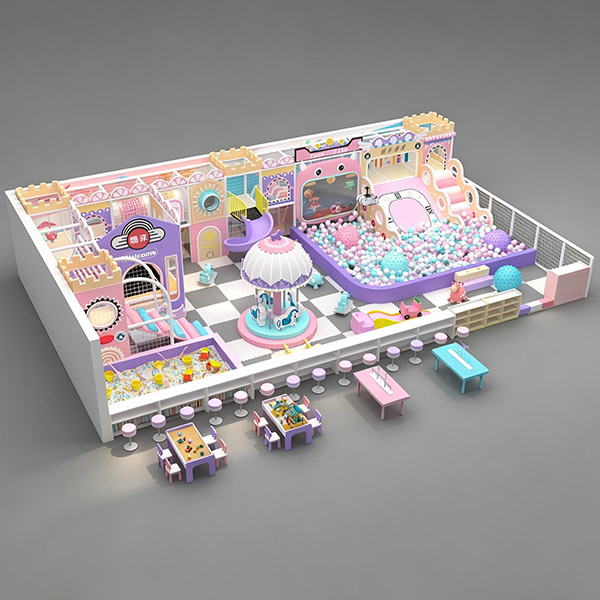
When transitioning from understanding the developmental benefits to actually planning a facility or play area, evaluating the available equipment is the critical next step. The market offers a highly diversified range of structures. Each is engineered to target specific age groups and spatial constraints.
For infants and toddlers, the physical environment must prioritize absolute safety, low-impact surfaces, and sensory engagement. Structures designed for this age group feature lower heights to prevent fall-related injuries and utilize ultra-soft foam. Typical components include low-profile crawling tunnels, shallow ball pits, and textured sensory mats. Because children in this bracket are highly prone to stumbling, the equipment must feature seamless vinyl stitching to prevent tripping hazards.
As children grow, their need for complex problem-solving increases. Multi-level play frames are engineered for older, agile children requiring greater physical challenges. These robust structures incorporate vertical climbing webs, enclosed spiral slides, suspension bridges, and interactive mechanical panels. Their structural integrity relies on a galvanized steel skeleton heavily padded with impact-absorbing foam. This allows children to run and jump safely.
For commercial operators, aesthetic differentiation is a primary driver of foot traffic. Custom themed playground equipment transforms a standard play area into an immersive narrative environment. Whether the design mimics a tropical jungle, a vibrant Macaron candy land, or a futuristic space station, thematic integration encourages imaginative, open-ended role-playing. Investing in themed aesthetics often translates directly to higher perceived value and increased repeat visitation rates.
Procuring infrastructure for an indoor facility is a significant capital expenditure. Making an informed purchasing decision requires a systematic evaluation of spatial limitations and strict adherence to technical safety compliance.
Evaluation Criteria | Standard Modular Setups | Custom Commercial Playgrounds |
|---|---|---|
Target Space | Small clinics, residential rooms, daycares | Shopping malls, family entertainment centers |
Core Materials | Standard density foam, basic PVC covers | 0.55mm marine-grade PVC, 48kg/m³ high-density sponge, galvanized steel |
Customization | Pre-packaged colors and shapes | Fully tailored themes, bespoke dimensions |
ROI Potential | Low direct revenue, adds baseline value | High revenue driver, acts as a primary anchor attraction |
Before reviewing catalogs, a precise spatial audit is mandatory. Buyers must calculate not only the available square footage but also the vertical clearance. Multi-level structures require specific ceiling heights to comply with safety regulations. Operators must account for fall zones and circulation pathways, ensuring adequate spacing for parents to supervise safely.
The foundational requirement of any soft play equipment is verifiable safety compliance. High-quality gear must adhere to rigorous international safety standards like ASTM F1918, CE, or EN1176. Look for specific engineering parameters. Premium materials must feature fire-retardant, lead-free 0.55mm PVC vinyl. The internal core should utilize high-density sponge that retains its shape under continuous compression, supported by heavy-duty galvanized steel pipes.
The application of padded play technology has expanded significantly. While originally confined to large-scale amusement centers, these environments are now utilized across diverse sectors.
In commercial settings like family entertainment centers, shopping malls, and pediatric therapy clinics, installing robust play structures is a strategic business decision. For malls, these installations serve as anchor attractions that increase dwell time and drive secondary spending. In therapeutic settings, occupational therapists utilize specialized foam ramps to assist children with motor delays. This demands equipment that can withstand high-volume daily use.
Driven by parents seeking screen-free physical activities, the demand for residential configurations has surged. When purchasing toddler play structures for a home, parents should apply the exact same rigorous safety standards used in commercial evaluations. Investing in commercial-grade materials ensures the equipment will last through multiple children without sagging or tearing.
The long-term viability of an indoor play space depends entirely on rigorous maintenance protocols. A poorly maintained facility poses health risks and rapidly degrades the lifespan of the equipment.
Padded surfaces are high-touch areas requiring consistent sanitization. Facilities must implement documented daily cleaning schedules using non-toxic, child-safe, hospital-grade disinfectants. Harsh chemicals like bleach should be avoided as they strip the protective coating from the PVC vinyl. Ball pits require automated washing machines weekly to extract, sanitize, and dry the plastic balls.
The lifespan of your equipment correlates directly with material quality and upkeep consistency. Premium marine-grade vinyl resists tearing, but operators must still enforce strict no shoes and no sharp objects policies. Beyond cleanliness, physical safety inspections must be conducted systematically. Checking for exposed metal, sagging safety nets, and loose structural bolts helps identify potential hazards before they result in injury.
Soft play environments do far more than simply burn off excess toddler energy. They actively build essential motor, social, and cognitive skills. By offering engineered, safe spaces for childhood development, these yielding structures allow kids to test their limits and grow their self-confidence without the looming threat of severe injury.
Whether you are a parent curating a dynamic playroom or a business owner aiming to boost commercial foot traffic, investing in durable, high-quality equipment ensures long-term safety and lasting value. Take the time to assess your spatial needs, prioritize premium certified materials, and explore the vast options available. Ready to build a profitable and safe indoor attraction? Visit Cheers Playground to find the exact themed structures and modular equipment to bring your vision to life today.
The primary benefits include the accelerated development of gross motor skills, vital sensory stimulation, and early social interaction. By providing an impact-absorbing environment, toddlers gain the physical confidence required to practice balancing, walking, and climbing without the fear of sustaining injuries from hard falls.
Most structured indoor play facilities are intentionally designed to cater to children ranging from 6 months up to 10 years of age. High-quality facilities utilize age-segregated zones. This keeps delicate infant and toddler areas strictly separated from the larger, complex multi-level frames used by older children.
All padded equipment should be cleaned daily using non-toxic, child-safe antibacterial wipes or specialized vinyl-safe disinfectant sprays. Avoid harsh abrasives or bleach, which degrade the material. High-touch zones like handholds, slide exits, and ball pits should be deep-cleaned weekly to maintain strict hygienic standards.
Yes, many reputable manufacturers produce scaled-down, modular play structures specifically engineered for residential environments. It is highly recommended to select products that utilize the same high-density polyurethane foam and fire-retardant, non-toxic vinyl covers required in commercial settings to ensure maximum safety.
When subjected to proper daily maintenance, regular deep cleaning, and strict adherence to user weight limits, high-quality commercial equipment typically lasts between 5 to 10 years. Longevity is highly dependent on the initial quality of the PVC vinyl and the promptness of repairing minor wear and tear.
To maintain material integrity and ensure child comfort, indoor play facilities should be kept at a stable temperature between 68 and 72 degrees Fahrenheit. Humidity levels should be strictly managed between 40 and 50 percent. Controlling humidity prevents the growth of mold and mildew on the vinyl covers and foam interiors.
Space requirements vary drastically based on the design, but a baseline commercial multi-level frame typically requires a minimum of 500 to 1,000 square feet. Crucially, operators must secure a minimum vertical clearance of 12 to 15 feet to safely accommodate multi-tier climbing structures and enclosed spiral slides while complying with international safety standards.


